Corrigenda

For clinics using an AI scribe

A record of what your AI scribe wrote, and who checked it.

Corrigenda keeps the AI draft and the approved text of every clinical note at your vårdcentral. Two classifiers flag likely errors overnight for a clinician you name to review, and your DPO gets the record.

Free for 7 days · no card required

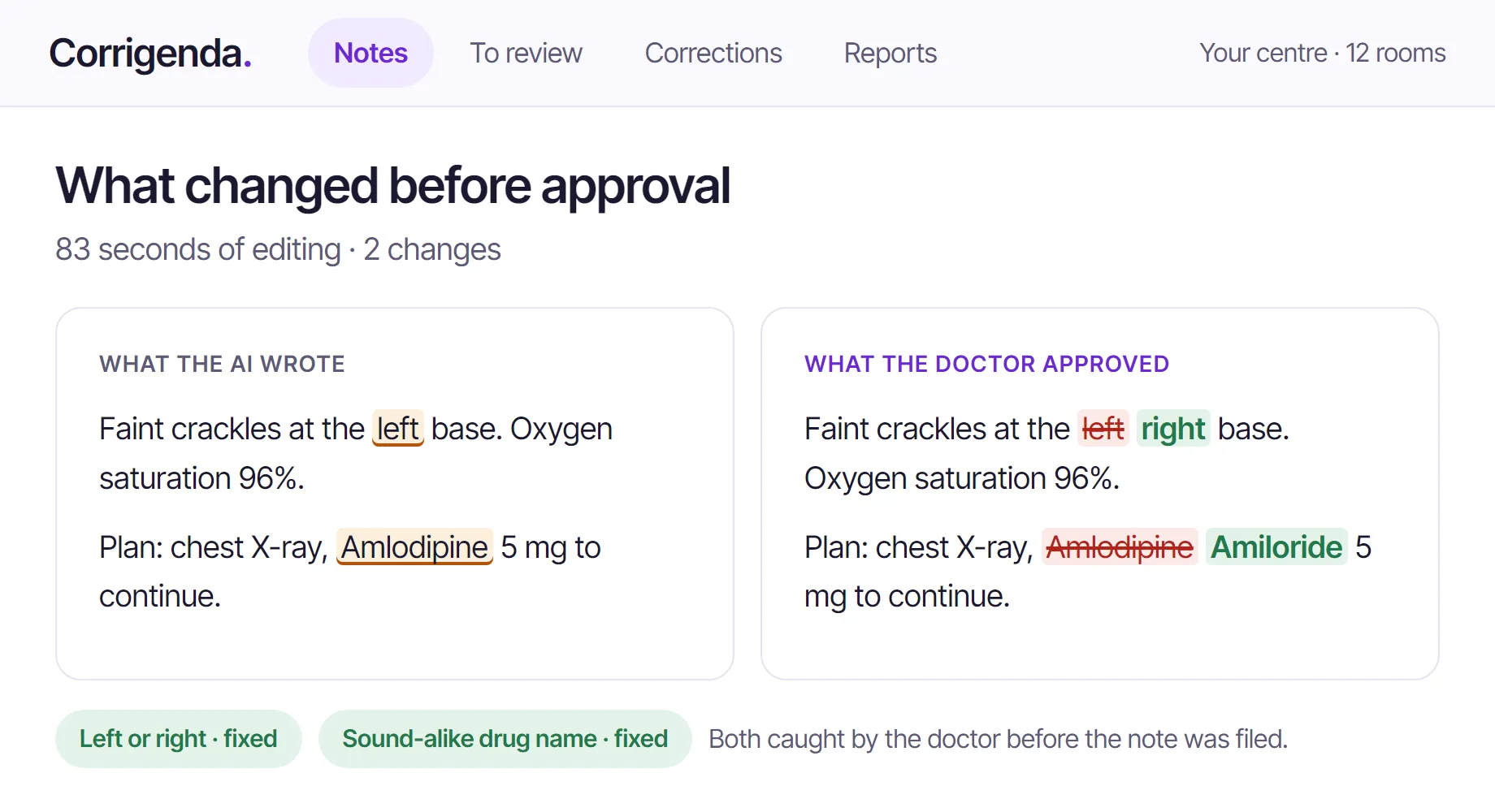
Your journal keeps only the final text. The AI draft disappears.

Corrigenda saves both when the clinician approves the note.

When the inspector asks how errors get fixed, you show the record.
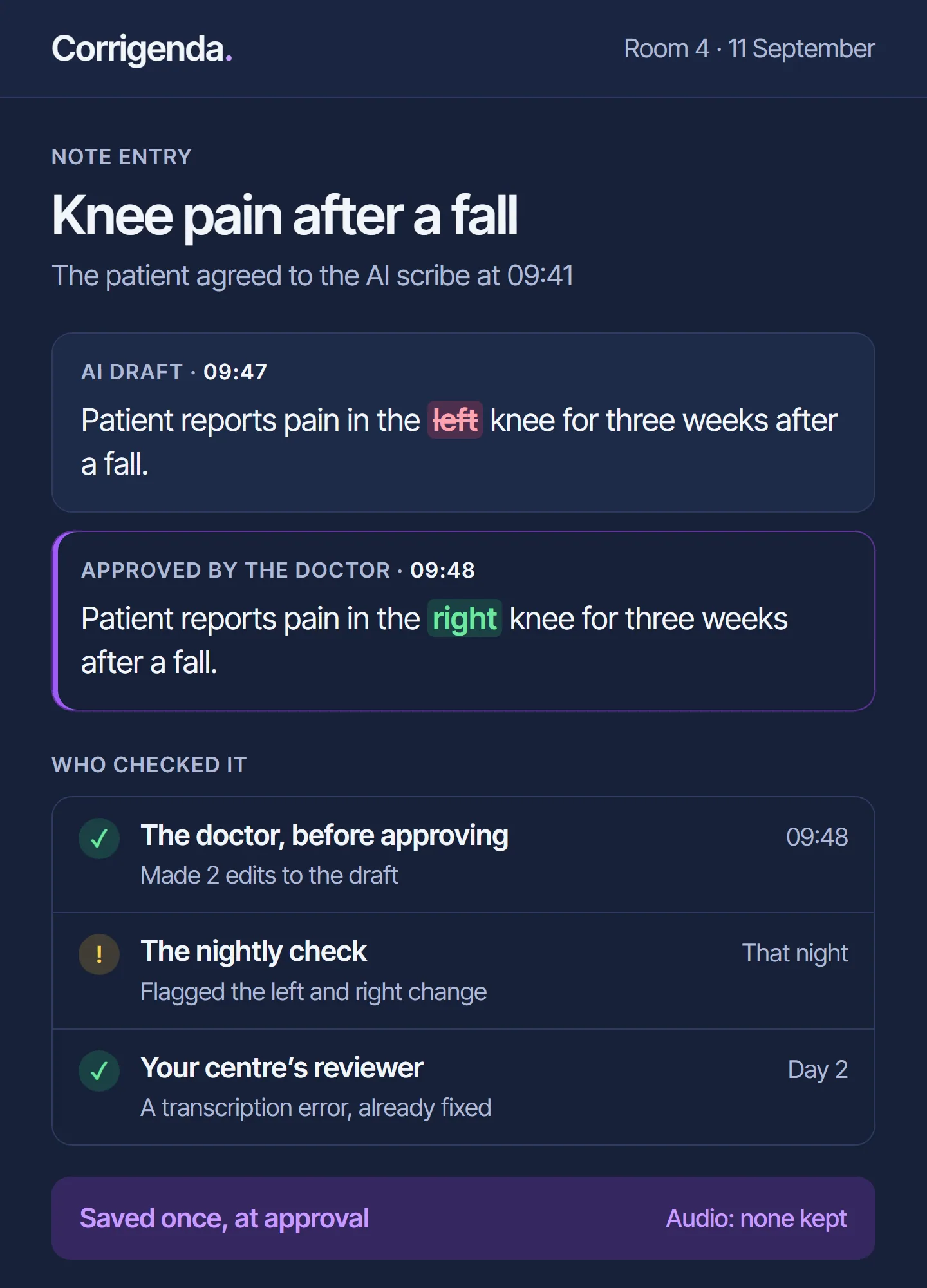
One note’s entry as a page: the AI draft above the text the doctor approved, left changed to right, and who checked it, from the doctor to the centre’s reviewer

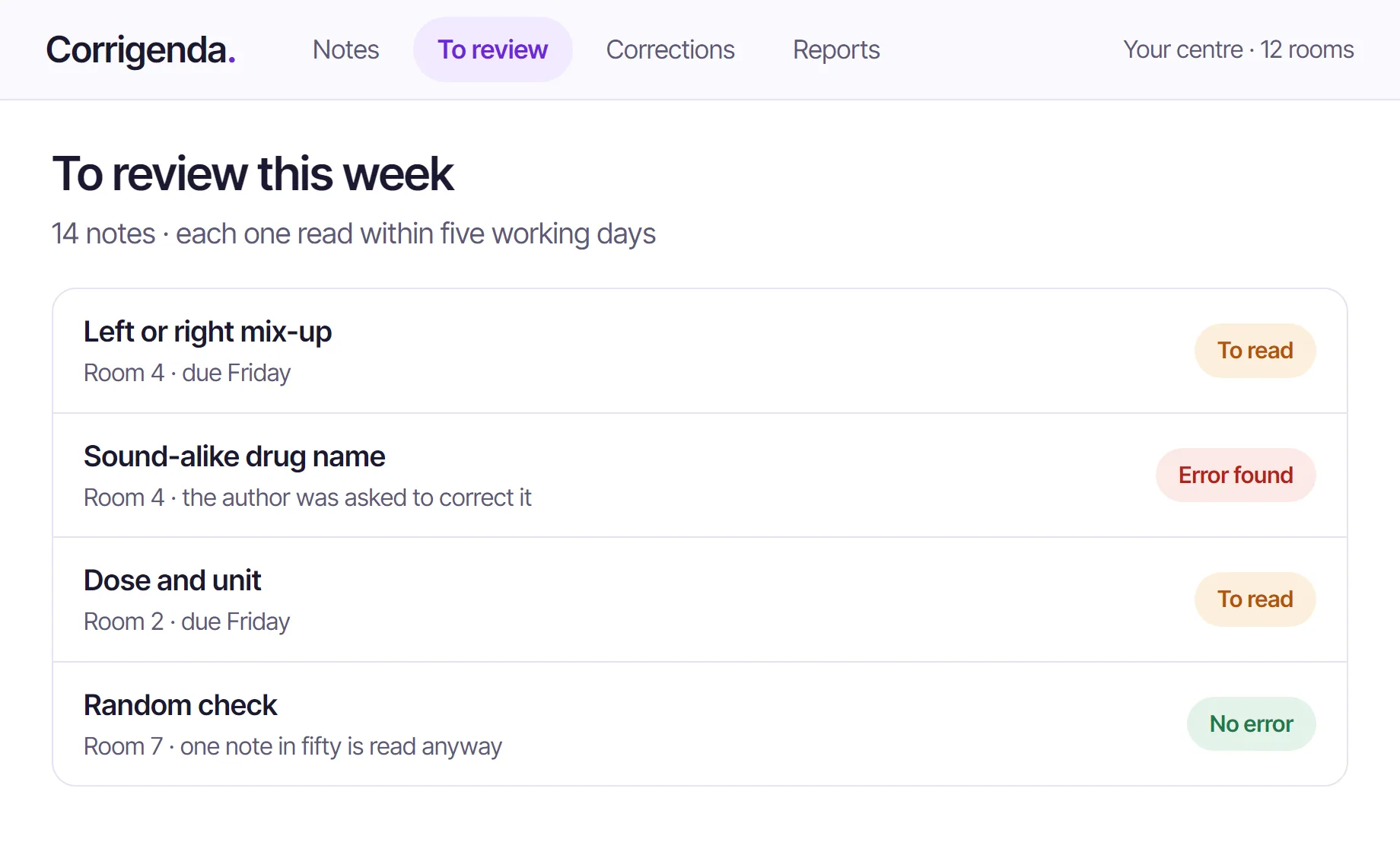
5 working days

the due date on every flagged note in your queue

€1,400

per centre per month, billed yearly

1 working day

to export a disputed note’s full history

Is this for you?

Worth it when someone will ask how a note was checked

This is for you if

  • ✓A vårdcentral of 20 to 80 staff using the scribe, with a clinician to name as reviewer.
  • ✓An inspector or a patient asked how one note came to be.

This is not for you if

  • ✕You want the audio recording back.
  • ✕Your clinicians use the scribe outside a browser your IT manages. We can’t capture there.
  • ✕You have two or three doctors and nobody who needs the report.
  • ✕Your scribe vendor’s Enterprise retention terms already suit you.

What it does and does not

We don’t write notes, keep audio or judge the medicine

We keep the history of a note your scribe has already written.

  • in scope01One entry per note, saved once at approval: consent, draft, final text, changes, author and time. Nobody can edit it.
  • in scope02A second read by a clinician you name, for transcription only. Never the diagnosis or the plan, and never by us.
  • we don't01No drafting. Your scribe listens, drafts and files the note once the clinician approves.
  • we don't02No audio. We never receive a recording, so we can’t tell you what was said in the room.

What a centre gets

A queue for your own reviewer, and a record of what they read

Your scribe charges per user: Pro is €125 per user per month. We charge per centre, however many clinicians, reviewers and notes you have.

◆

Consent mark

one click per consultation, in the browser or in Azure Virtual Desktop. A no is logged too.

▲

Draft vs final

every change labelled: transcription fix, rewording or formatting

●

Nightly check

sound-alike drug names, doses, left or right, and dates

■

Review queue

flagged notes and a 2% sample for the clinician you name, with due dates

◇

Correction log

the author fixes the journal and closes the request with a reference

△

DPO console

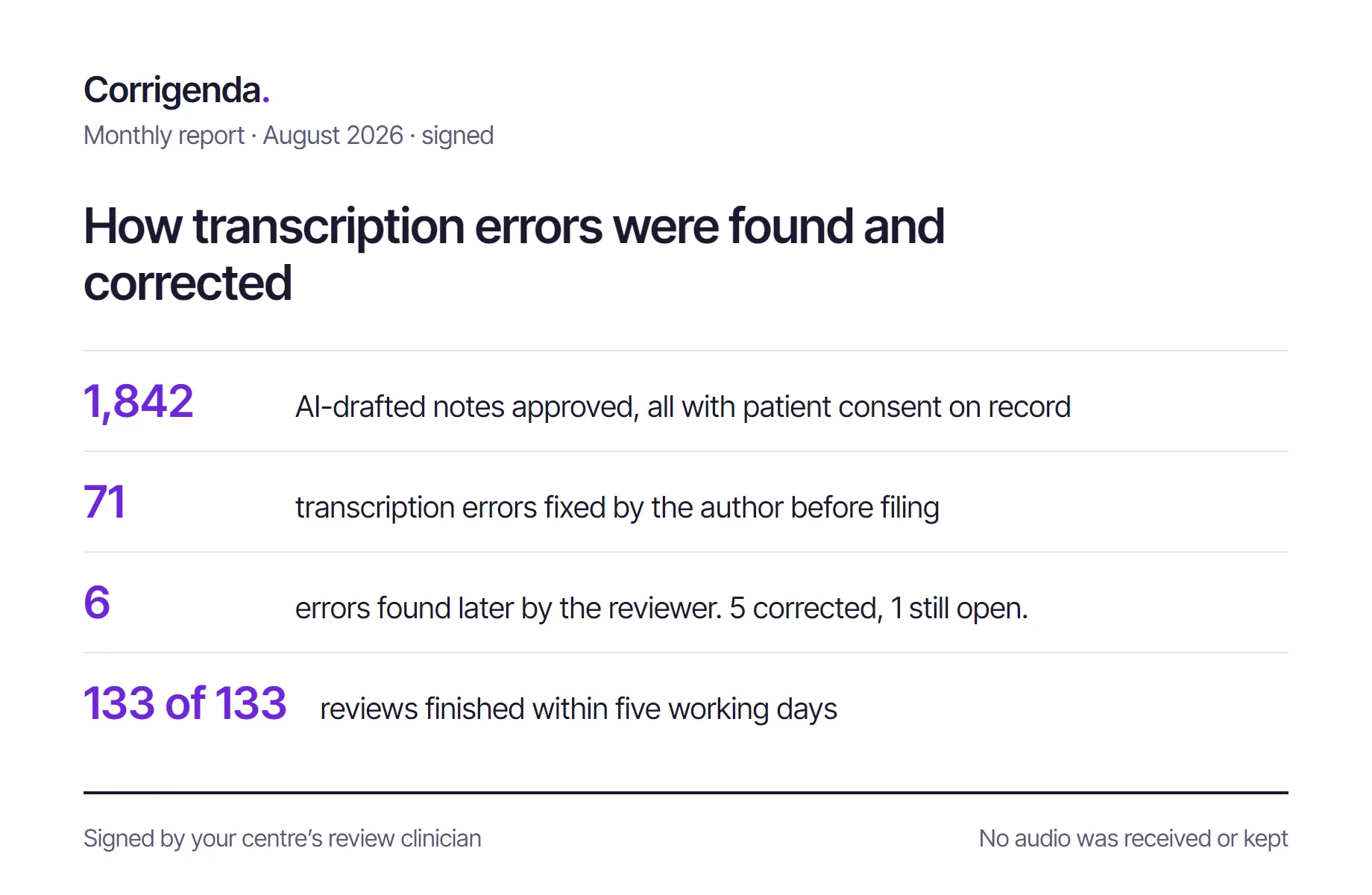
open requests, capture gaps and a signed monthly report

Scored each night

Flagged by two classifiers, decided by a clinician on your staff

One reads the approved text for missed transcription errors; the other sorts each edit made to the AI draft by kind.

◆

Rules first

the drug-name, dose, left-right and date checks find about a third of the errors reviewers confirm

▲

Your region’s model

a Swedish-language model we run reads the rest, fine-tuned only on your reviewers’ verdicts

●

Above 0.7

a passage goes to your reviewer’s queue. Under that, only the 2% sample can bring a note to them

■

Your reviewer

gives the verdict on each flagged passage; any correction is the author’s, made in the journal

Why

We capture the draft on screen, and save it once

Capture is a browser extension your IT installs, with no feed from the scribe vendor. The region is under supervision, so the record is the region’s.

Patients were told nothing is recorded without consent. Keeping audio would reopen that question with every patient.

Corrections are added after the entry, and the author fixes the journal itself.

  • If the scribe changes its screens, capture breaks until our next update.
  • A wrong consent click stays on record, with a note saying so.
  • An ignored correction request stays open, where your DPO can see it.

One screen

One note’s entry, as you see it

Everything the inspector’s question needs, in one place.

Note entry · 3 June 2026
consent
Confirmed at 09:14, one click by the author
AI draft
412 words
final text
398 words, approved at 09:31 by the author
changes
6 edits: 4 transcription fixes, 1 rewording, 1 formatting
flagged
A drug name, caught by the nightly check
reviewer
Error confirmed. Correction requested on day 2.
correction
Fixed in the journal on day 4
audio
None kept
One note’s entry, saved at approval and never edited

Not the journal and not a recording. The fix itself is made in the journal by the author. This entry points to it.

To start, sign the order form and the region’s processing agreement, install the extension at one centre, name its reviewer and ask for twelve months of past notes.

From then on you have an entry per note, a correction log and a signed monthly report per centre.

A disputed note’s full entry is exported within one working day.

Pricing

Priced per centre, because that’s who the inspector asks

  • Centre

    €1,400per centre / month, billed yearly

    One vårdcentral with its own centre head, however many clinicians use the scribe.

    • A review queue for the clinician you name, with due dates and reminders
    • Every flagged note and a 2% random sample queued, each due in five working days
    • One locked entry per note, with the AI draft next to the final text
    • A correction log, closed with a journal reference
    • A signed monthly report, and disputed notes exported in one working day
    • Never charged: the extension, past notes, exports and the console
  • RegionOne contract

    €1,100per centre / month, from ten centres

    One contract for a region’s primary care, with one DPO console across every centre.

    • Everything in Centre, at every centre
    • How each scribe update changed the edit rate, region-wide
    • One DPO console for all centres
    • Centres added mid-year pay only for the months left
  • Supervision contract

    By quotationfor a care provider under an open case

    A named account contact, every disputed note exported in one working day, and past notes loaded before rollout.

    • A named account contact at Corrigenda for the case
    • Disputed notes exported in one working day, at every centre
    • Twelve months of past notes loaded before the extension rolls out
Try it now
  • Sixty days at your first centre before any invoice
  • No invoice if we capture under 95% of sessions by day sixty
  • No card. One yearly invoice, under the region’s own data agreement
  • Leave at year end and take the full record, in open formats

Book a call. Bring one disputed note.

Your name, phone number and country. We call within two working days, and first we ask which region you are in.

Routed to whoever covers that country. One business day, either way.

We reply within one business day.

  • ✓ Not for solo practitioners or clinics of three doctors
  • ✓ Your reviewer has a login on day one
  • ✓ Your last twelve months of notes scored within a week
  • ✓ The extension, past notes and exports are never charged

Your request has been received.

Expect a message from Corrigenda. It goes to the address you gave.